Got a tip for us? Share it...

Archive of Mac Pro Rumors

While Apple offered a sneak peek at its dramatically redesigned Mac Pro at its Worldwide Developers Conference, the new machine is not scheduled to launch until "later this year" and the company has yet to reveal detailed specs and pricing information.

But if a new Geekbench result is authentic, it appears that the new machine is already starting to show up in public benchmarking databases. Rather than showing up as a "MacPro6,1" as would be expected for Apple's next-generation Mac Pro, the new machine is dubbed "AAPLJ90,1", perhaps a reference to a J90 code name following Apple's usual format.

mac_pro_2013_geekbench
Also supporting the authenticity of the entry is the listing of a custom build of OS X Mavericks, 13A2054, running on the machine. The listed motherboard ID is also one which was discovered in OS X Mavericks as corresponding to the new Mac Pro.

The machine in question is running a single 12-core processor from the upcoming Ivy Bridge-E family, specifically the Xeon E5-2697 v2 running at 2.7 GHz. It is also equipped with 64 GB of RAM.

A comparison of this new Mac Pro entry with Apple's current high-end 12-core Mac Pro running a pair of 3.06 GHz Westmere processors reveals improved performance on Geekbench benchmarks by most measures, ranging from slight improvements for certain tasks to substantial improvements for others.

mac_pro_2013_geekbench_comparison
We chatted with John Poole of Primate Labs, who highlighted the substantial improvements in many single-core measures and in memory performance, suggesting that lower multi-core scores later in the Integer Performance testing run could be indicative of thermal issues.

Poole notes that with a public launch of the new Mac Pro likely still many months away, it is entirely possible that Apple is still ironing out both software and hardware issues on the new Mac Pro and that the company's work could lead to even more substantial performance gains once those issues are addressed.
Last December, Apple CEO Tim Cook revealed that Apple would be bringing some Mac production back to the United States. He offered more details on the effort last month, and earlier this week the company announced that its radically redesigned Mac Pro coming later this year will be the product line assembled in the U.S.

Apple had been presumed to be working with current manufacturing partner Foxconn on the U.S. production, but KGI Securities analyst Ming-Chi Kuo told Taiwan's Economic Daily News [Google translation, via Macotakara] that Apple will actually be partnering with Flextronics for the new Mac Pro.

mac_pro_2013_later_this_year
Last week, we received an unconfirmed tip making a similar claim about Flextronics' role in the "Made in the USA" Mac, with the source alleging that Flextronics will be assembling the product at its new facility in Texas. That claim is line with Tim Cook's disclosure during a Senate hearing on Apple's tax practices last month that the product would be assembled in the state.

Flextronics' new Texas facilities are housed in a 450,000 square foot building in Fort Worth formerly used by Nokia. Flextronics will be using the site for production of Motorola's Moto X smartphone, but our source indicated that Apple's production will also take place there.

Apple's new Mac Pro will be launching later this year, but Apple has yet to reveal pricing or a more specific launch timeframe following Monday's "sneak peek" at the company's Worldwide Developers Conference keynote.
2013_mac_pro
At today's WWDC keynote event, Apple offered a sneak peek of its next-generation Mac Pro, a line of desktop computers that has not received a significant update in several years. The preview began with a teaser video showcasing the radically redesigned tubular tower.
The next generation Mac Pro is architected around an ingenious unified thermal core that allows the desktop to efficiently share its entire thermal capacity across all the processors. The result is a pro desktop with breakthrough performance packed into a design that is one-eighth the volume of the current Mac Pro. Next generation Intel Xeon E5 processors with up to 12 core configurations deliver double the floating point performance. With two AMD FirePro workstation-class GPUs, the all-new Mac Pro is up to 2.5 times faster than the current Mac Pro and delivers up to an amazing 7 teraflops of compute power. The new Mac Pro also features PCIe-based flash storage that is up to 10 times faster than conventional desktop hard drives and includes the latest four-channel ECC DDR3 memory running at 1866 MHz to deliver up to 60GBps of memory bandwidth. With all that power, the new Mac Pro lets you seamlessly edit full-resolution 4K video while simultaneously rendering effects in the background.
New generation Intel Xeon processors, ECC memory, and new PCIe flash storage will debut in the new Mac Pro. External expansion will be available via six Thunderbolt 2 ports and graphics will be handled by dual workstation AMD FirePro GPUs with support for up to three 4K displays.

f1370887342
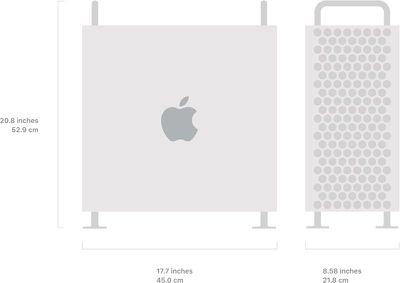
Compared to the previous Mac Pro, the next-generation model is approximately 1/8 the size. The new Mac Pro will also be assembled in the United States. A special WWDC session tomorrow will see representatives of The Foundry and Pixar showing off how The Foundry's MARI 3D digital paint tool can take advantage of the upcoming Mac Pro hardware.
The new Mac Pro model, expected later this year, is "something really different" according to a video professional who says he spoke with the Mac Pro product manager.

Writing on the RedUser.net forum, Andrew Baird says he spoke to Mac Pro project manager Douglas Brooks on the phone after emailing CEO Tim Cook with his concerns about the lack of a new professional tower from Apple over the past few years.

Baird told MacRumors that the call didn't include any specific details about when the new machine would be released, nor its specifications -- however, he was assured several times that the new Mac Pro would be worth the wait. Brooks told him that the machine would be released later this year.

mac_pro_2010_side_top_half
For what it's worth - a couple of months ago I received a call from Douglas Brooks, Apples project manager for the new Mac Pro to address my concerns about the new machine. Obviously he didn't tell me anything about the new MP, but asked me what I wanted to see. I told him expandability for extra graphics cards support, and memory expansion were at the top of my list amongst other things. His reply was simple:

"You are going to be really glad that you waited [to buy a new tower]. We are doing something really different here and I think you're going to be very excited when you see what we've been up to. I can't wait to show this off".

That conversation gave me enough confidence to wait for the new machine. I'm looking forward to the announcement. Hopefully the wait will be worth it.
Somewhat corroborating Baird's phone call, Lou Borella -- administrator of the 'We Want a New Macpro' Facebook group -- wrote on the page that he heard the new professional Mac would be "heavily reliant on Thunderbolt" with "no internal expandability", and would have support for dual-GPU's and no FireWire or optical drive.

In mid-2012, after a minor update to the Mac Pro was announced at WWDC, Tim Cook confirmed to a fan that new Mac Pros were coming in 2013, which was later reiterated by an Apple spokesman. It has also been rumored that the new Mac Pro would be the first Apple computer in years to be 'Made in the USA'.
wwdc_2013_logoWith Apple's annual Worldwide Developers Conference (WWDC) kicking off next Monday, June 10 at 10:00 AM Pacific Time with a keynote address, it's time for a roundup of rumors about what we might see at the event.

In announcing the conference back in late April, Apple unsurprisingly revealed that it will be delivering "new versions of iOS and OS X" to developers, undoubtedly referring to iOS 7 and OS X 10.9. And as has become tradition since Apple moved its iPhone launches later in the year starting in 2011, WWDC 2013 is indeed expected to live up to its developer focus with an emphasis on software.

iOS 7

iOS 7 will almost certainly make its consumer debut alongside updated iPhone hardware later this year, but WWDC will offer the first glimpse of the upcoming software and Apple should spend a fair amount of the keynote walking through the changes. Apple will also begin seeding versions of iOS 7 to developers at WWDC, giving them time to help test the operating system itself and to build and update their own apps to take advantage of new features coming in iOS 7.

The big discussion surrounding iOS 7 has been regarding a new "flat design" driven by Jony Ive, who took over control of Apple's software-focused Human Interface team late last year in addition to his longtime role as head of Industrial Design. Prominent rumors for iOS 7 include:

- Image of 'Flat' Redesign From Early iOS 7 Build Reportedly Leaks
- iOS 7 May Include AirDrop Wireless File Sharing Capabilities
- More Details on Jony Ive's Flat iOS 7 Design: Heavier on Black and White
- Apple to Expand Social Network Integration in iOS 7 with Support for Flickr and Vimeo
- Surge in Apple's iOS 7 Usage Revealed in Web Traffic Stats
- Apple Engineers Working Overtime on iOS 7's 'DeForstallization'
- Apple Looking to Boost In-Car Integration of Maps and Siri in iOS 7
- Details on Jony Ive's 'Very, Very Flat' Design for iOS 7
- iOS 7 Running Behind, Rumored to Have Significant Visual Makeover

ios7icons.jpg
Claimed early alpha version of iOS 7 with flatter look

OS X 10.9

For this year's OS X 10.9, many had been expecting Apple to mirror its 2012 OS X Mountain Lion schedule with developer previews beginning around February ahead of a late summer public launch, but despite a evidence of the next version of its Mac operating system showing up in web blogs late last year, the company has yet to make any public announcements about the update.

Back in April, Daring Fireball's John Gruber reported that with iOS 7 having been running behind schedule, Apple had been pulling engineers from OS X 10.9 in order to assist with the iOS work. The report was later confirmed by AllThingsD and The Loop, although it seems unclear whether the shift had any effect on Apple's internal timeline for OS X 10.9. Details on what to expect in OS X 10.9 have been relatively scarce, but rumors have included:

- OS X 10.9 to Bring Enhancements to Finder, Safari, Multiple Monitor Support, and Multitasking
- Apple Job Posting Hints at Siri for Macs in OS X 10.9
- OS X 10.9 to Include Siri and Maps Integration

"iRadio"

itunes_radio_round_iconApple has been rumored to be working on a Pandora-like streaming radio service for quite some time, but difficult negotiations have reportedly slowed the effort considerably. Just weeks ago, it was reported that continued difficulties with record label and publisher negotiations might result in Apple being unable to unveil the service at WWDC, but just this past weekend Apple signed Warner Music in what appears to be a last-minute push to secure deals in time for a WWDC announcement. The service would not, however, launch until later this year alongside iOS 7.

The service, informally dubbed "iRadio", is said to be free to users, relying on advertising support through Apple's iAd team to generate revenue. Apple is reportedly seeking to deploy a service similar to that offered by Pandora but with additional flexibility for users.

Notebook Updates

With Intel having announced a series of new Haswell chips yesterday, Apple's Mac lineups may be ready for updates. Apple's notebook lineup appears to be the primary target for updates at WWDC, with reliable analyst Ming-Chi Kuo calling the notebook refresh the hardware highlight of WWDC. Leaked model numbers have hinted at notebook updates for WWDC, although the identities of the products associated with those numbers have not yet been confirmed.

macbook_air_macbook_pro
Upgrades will primarily be internal with the shift to Haswell, although Kuo believes that the 13-inch Retina MacBook Pro may see a slimmer design. Other rumored upgrades include a shift to full HD (2.0-megapixel) FaceTime cameras on the Retina MacBook Pro models and adoption of a dual-microphone system on the MacBook Air to improve sound quality. Kuo believes that Apple will continue to offer the non-Retina MacBook Pro, but handicap the line by continuing to offer Intel's older Ivy Bridge chips in a bid to push consumers to the thinner and more expensive Retina MacBook Pro models. Apple may also be upgrading to faster 802.11ac Wi-Fi in its next-generation machines.

Mac Pro?

Following a disappointing update for the Mac Pro last year, coming approximately two years after the previous update, Apple took the unusual step of confirming that the company would have a redesigned Mac Pro for "later" in 2013. Some rumors had suggested that Apple might launch the new Mac Pro this spring, but the update failed to come to fruition. Apple has even been forced to halt sales of the current Mac Pro in Europe over non-compliance with certain safety requirements.

WWDC represents a reasonable opportunity for Apple to update the Mac Pro given the developer and professional focus for the conference, and stocks of the workstation are said to be running low. Timing may not, however, be in Apple's favor, as at this point the Mac Pro would be expected to adopt Intel's Ivy Bridge E processors, the full line of which is not expected until around September of this year. Still, it is possible that Apple could announce a new Mac Pro at WWDC with availability scheduled for the future.

Live Keynote Coverage

The WWDC 2013 keynote kicks off at 10:00 AM Pacific Time on Monday, June 10, and we will be providing live updates here. We will also be issuing Twitter updates through our @MacRumorsLive account. Separate news stories regarding the event announcements will go out through our @MacRumors account.
wwdc_2013_logo9to5Mac reports that it has received an initial set of leaked model numbers for products expected to be released at next week's Worldwide Developers Conference.
The first series of codes that we have received are:

MD711LL/A — Better — USA

MD712LL/A — Best – USA

MD760LL/A — Better – USA

MD761LL/A — Best – USA
While the identities of the products corresponding to the four model numbers is unknown, the pattern showing two sets of two models suggests that they may be either MacBook Air or Retina MacBook Pro models at two different screen sizes, corresponding to Apple's current stock configurations. Apple's non-Retina MacBook Pro is currently offered in only a single stock configuration at the larger 15-inch size, suggesting that these model numbers may not represent that line.

A second set of model numbers have also leaked, but it is unclear to what products they refer:
ME177LL/A — Better — USA

ME182LL/A — Best — USA

ME918LL/A — Good — USA
A notebook refresh is expected to the hardware highlight of WWDC, although Apple is likely to introduce a number of new products once accessories and configuration options are accounted for.

9to5Mac also notes that, beyond the notebooks, supplies of the Mac Pro and Mac mini are also somewhat constrained, although not to the same level as seen for notebooks. As a result, desktop updates may come somewhat later in the year.
Earlier this month, we reported that Apple resellers were seeing dwindling numbers of MacBook Airs, and it appears that many outlets are also experiencing low supplies of Apple's Mac Pro.

According to MacTrast, the entry level quad-core 3.2GHz Mac Pro is backordered or out of stock at a number of online stores, including MacMall, B&H Photo, CDW, PowerMax, Adorama, and J&R Electronics.

macpro
Popular Apple reseller Amazon.com has just nine of the low end Mac Pros in stock, and other retailers like MicroCenter, Frys, and Best Buy also have limited supplies.

Dwindling product supplies at third-party Apple retailers is often an indication that a refresh is imminent and the Mac Pro may be a prime candidate for an update announcement at WWDC in June, as it has been more than 1,000 days since the product last saw a significant release.

The Mac Pro received a slight update at WWDC last year, which included a small processor bump. Many Apple customers were dissatisfied with the update, but an Apple spokesman later confirmed that a new Mac Pro would be introduced in 2013.

One issue for Apple is likely to be processor availability, as the company has traditionally used high-end Xeon chips from Intel in the Mac Pro. The next-generation Xeon chips, Ivy Bridge-E, are not expected until around September of this year, a date far enough off that it would be difficult for Apple to announce a new Ivy Bridge-E Mac Pro at WWDC but close enough that Apple would have a difficult time justifying use of the current Sandy Bridge-E chips that have already been on the market for quite some time.
Digitimes reports that Apple has essentially halted all component orders for its Mac product lines, apparently working through significant inventories of components delivered during an aggressive ramp-up late last year that may have proven overly aggressive.
The suppliers originally expected to finish digesting their Mac inventories in April, but are now stranded waiting for further instructions from Apple.

The sources revealed that Apple's Mac orders to the supply chain dropped to almost nothing after the Lunar New Year holidays. Apple had high hopes for its Mac product lines and placed aggressive orders at the end of 2012; however, the company is now badly affected by the decision.
The report claims that Apple generally provides shipment forecasts to its supply chain partners at the beginning of each quarter, but the company has not done so for the second quarter. The lack of information has reportedly left suppliers wondering when they will be able to resume production.

Just last week, Digitimes claimed that Apple is likely to refresh its notebook lineup at the end of the second quarter, so it seems that suppliers may need to start ramping up production for new models in the relatively near future.

mac_lineup_early2013
Apple frequently has to juggle its supply chain as it approaches product updates, seeking to accurately estimate consumer demand in order to deplete its existing inventories just as the new models are released. But if today's report is true, it seems that Apple may have overestimated customer demand for the early part of 2013 and is now finding itself with substantial inventories heading into its next round of product updates.

Apple CEO Tim Cook has also warned about reading too much into rumors from Apple's supply chain, noting that its "very complex" nature makes it difficult to accurately interpret what is actually going on from limited data points, even if that data is accurate.
MacDailyNews, which does not have much of a track record on rumors, says one of its sources said Apple will announce a replacement to the Mac Pro at some point in the next several months.

Macpro 1
Apple will announce its replacement for the company’s Mac Pro lineup this month, a source who has been correct about Apple product matters in the past has just informed us.

Our source offered no information as to whether the "Mac Pro replacement" would be a tower, mini-tower, or some other solution, but did caution that the announcement "could slip into May or even June, but currently April looks most likely."
It has been nearly one thousand days -- almost three years -- since the last significant update to the Mac Pro.

Last year, Apple said a new Mac Pro model was likely to arrive sometime in 2013. Earlier this year, a European reseller claimed they heard from Apple that a new Mac Pro would arrive this Spring. WWDC 2013 would seem to make the most sense for the announcement of a new pro-level Mac workstation.

The current Mac Pro is not available for purchase in Europe because of EU regulatory requirements around unprotected fan blades, providing some additional incentive for Apple to release a new model.
Just two weeks after Sapphire introduced the Radeon HD 7950 Mac Edition graphics card for the Mac Pro, EVGA today announced the launch of its GeForce GTX 680 Mac Edition. Based on the popular year-old card for PCs, the new GeForce GTX 680 Mac Edition carries 2 GB of GDDR5 memory and adds another high-end graphics option for current Mac Pro users.
The EVGA GeForce GTX 680 Mac Edition graphics card provides many new and key features:

1. NVIDIA GPU Boost Technology - Dynamically maximises clock speeds to push performance to new levels and bring out the best in every game.
2. Support for four concurrent displays; two dual-link DVI connectors, HDMI and DisplayPort 1.1
3. NVIDIA SMX Engine - Brand new processing engine which delivers twice the performance/watt compared to previous generations.
4. NVIDIA CUDA Technology - Unlocks the power of the GPU's processor cores to accelerate the most demanding tasks such as video transcoding, physics simulation, ray tracing and more.
5. OpenGL 3.2 (4.3 in Windows) Support - Support for the most widely-used open graphics standard in the world.
6. OpenCL Support - Supports the latest standards in GPGPU computing.
7. Boot Camp Support - Full support for Microsoft Windows operating system in Apple Boot Camp.
evga_gtx_680_mac
EVGA did not announce pricing or a launch date in its press release, but Newegg.com is currently listing a $599.99 price tag and a launch date of April 8. The is compatible with Early 2008 Mac Pro (MacPro3,1) and newer models with PCI Express 2.0, and requires OS X 10.8.3.
After previewing its Radeon HD 7950 Mac Edition graphics card at CeBIT earlier this month, Sapphire Technology today officially announced the launch of the new card.

sapphire_radeon_7950_mac
Exclusive to SAPPHIRE, the HD 7950 Mac Edition is based on AMD’s latest Graphics Core Next (GCN) architecture. This highly acclaimed architecture delivers a significant graphics performance boost for Mac Pro users in a wide range of applications including gaming, audio or video editing and content creation. For example, gaming frame rates are increased by over 200%, general benchmark performance increased by around 30% and graphics intensive benchmarks increased by as much as 300% compared with the NV 8800GT commonly used in these machines (SAPPHIRE internal data).

The SAPPHIRE HD 7950 Mac Edition is equipped with 3GB of the latest GDDR5 memory, and its Dual Asynchronous Compute Engines (ACE) deliver up to 2.87 TFLOPS Single Precision compute power. It provides hardware support for Open GL 4.2 and Open CL 1.2 as well as AMD HD3D technology and APP acceleration.
The new Mac Edition card contains a switchable BIOS that allows it to be used in either a Mac or a PC, and offers an HDMI port with 3D support, two Mini DisplayPort connectors, and a dual-link DVI port.


Newegg.com is offering the Radeon HD 7950 Mac Edition for $479.99 and has posted a video overview of the new card.
As noted in our forums, Apple's latest OS X 10.8.3 beta seeded to developers as build 12D76 yesterday contains new drivers for NVIDIA's high-end Quadro K5000 graphics card. NVIDIA announced the Quadro K5000 for the Mac Pro last September, but has yet to actually release the product.

k5000_drivers_10_8_3
The first developer build of OS X 10.8.3 seeded last November added AMD Radeon 7000-series drivers, so it appears that the public release of the operating system update will include support for several high-end graphics options. Just yesterday, we noted that Sapphire was previewing its Radeon HD 7950 Mac Edition graphics card at CeBIT.

Apple has not yet revealed when it will be releasing OS X 10.8.3 to the public, but we've heard that the latest build was distributed to company employees as a pre-release version, so it seems that its debut may be very close after over three months of developer testing.

Apple is expected to release a revamped Mac Pro sometime this year, although it is unclear exactly when the company is planning for the workstation to make its debut.
As noted by Accelerate Your Mac and tonymacx86, German site PCGamesHardware.de reports [Google translation] that Hong Kong-based company Sapphire Technology is previewing its new Radeon HD 7950 Mac Edition graphics card at CeBIT this week. The high-end card arrives following Apple's introduction of Radeon HD 7000-series drivers in OS X 10.8.3 betas last November, although the update has yet to be released to the public.
At Cebit we saw the Radeon HD 7950 Mac Edition for the first time live. The upper-class graphics card based on the original HD 7950, which uses dark brown board waived a boost function and is clocked at 800 MHz (GPU). The 3 GiByte GDDR5 memory, as well as its clock of 2,500 MHz, unchanged.
Sapphire is reportedly planning to price the Radeon 7950 Mac Edition at $450.

sapphire_radeon_hd_7950
Mac Pro news and rumors are beginning to pick up steam following Apple's promise last June that "new designs" of the workstation would be arriving in 2013. Last month, Apple ceased European sales of the current Mac Pro due to its non-compliance with new safety regulations, increasing the urgency of an update, while just yesterday a report surfaced about Apple-branded 2 TB solid-state drives for the Mac Pro.
As noted by 9to5Mac, the Mac Pro is no longer available for purchase from Apple's European Online Stores.

In late January, Apple informed its European distributors that sales of the Mac Pro would cease as of March 1st due to new regulatory requirements that go into effect on that date. At the time, Apple told resellers that it would accept orders up until February 18, a deadline that appears to apply to general consumers as well.

macprodiscontinued
The Mac Pro is no longer able to be sold in Europe because it is not compliant with Amendment 1 of regulation IEC 60950–1. According to information from Apple, the issue has to do with the Mac Pro's unprotected fan blades. Compliance with the new regulation would require fan guards and increased protection of the ports on the electrical system.

Apple's Mac Pro is now unavailable in European Union countries, EU candidate countries, and the European Free Trade Association countries of Iceland, Liechtenstein, Norway, and Switzerland.

Though the Mac Pro has been discontinued in Europe, resellers are still able to sell remaining product after the March 1st deadline. Apple plans to continue to support existing Mac Pro machines and will supply replacement parts.

Apple has also announced plans to offer a redesigned Mac Pro in 2013, following a minor update in 2012.
French Apple Reseller France Systems sent out a newsletter to its customers on the news that Apple will be halting sales of the Mac Pro on March 1st, 2013 due to new EU regulatory requirements.

macpro
As noted by both Mac4Ever and MacGeneration, the reseller also reports in that newsletter that they have heard from Apple that a new Mac Pro will be arriving in Spring of 2013. Translation:
However, we believe that the judgment of the Mac Pro is temporary, Apple informs us that new Mac Pro will be released in spring 2013.
While Apple typically doesn't leak such information, even to resellers, they have been strangely candid about a 2013 Mac Pro revision. In June, after a disappointing revision to the Mac Pro, an Apple spokesperson confirmed that Apple was working on a new Mac Pro for release in 2013.

Update: Apple declined to comment to Ars Technica about the reseller's claims, merely pointing back to earlier comments by Tim Cook about a new Mac Pro coming "later" in 2013.
Apple today issued a notice to European distributors indicating that it will halt sales of the Mac Pro in Europe and select other countries as of March 1 due to new regulatory requirements going into effect on that date. The move will affect all European Union countries, as well as EU candidate countries and the four European Free Trade Association countries: Iceland, Liechtenstein, Norway, and Switzerland.
As of March 1, 2013, Apple will no longer sell Mac Pro in EU, EU candidate and EFTA countries because these systems are not compliant with Amendment 1 of regulation IEC 60950-1, Second Edition which becomes effective on this date. Apple resellers can continue to sell any remaining inventory of Mac Pro after March 1.

Apple will take final orders for Mac Pro from resellers up until February 18th for shipment before March 1, 2013.

Countries outside of the EU are not impacted and Mac Pro will continue to be available in those areas.
mac_pro_2010_side_top_half
It is currently unclear exactly what aspect of the regulation the current Mac Pro will fail to meet.

Apple has uncharacteristically announced that a redesigned Mac Pro is due in 2013 after a lackluster update in June 2012 that included still-outdated processors and no other seemingly obvious improvements like USB 3.0 or Thunderbolt.

Update 10:17 AM: Macworld provides a bit more detail on where the current Mac Pro fails to meet the new regulation.
[U]nfortunately for EU customers, the Mac Pro does not comply with this standard, due to issues with power provided to its I/O ports and the placement of its fan guards. The Pro is the sole Apple product to fall under this ruling, likely due to its build - the desktop computer hasn’t had an overhaul since 2010, with a minor speed bump last June.
Update 10:21 AM: Apple has issued a statement to The Loop confirming the halt for Mac Pro sales, but not offering any additional detail on the situation.
"Due to evolving regulatory requirements, Apple will stop selling Mac Pro in EU, EU candidate and EFTA countries on March 1, 2013," an Apple representative told The Loop. "After that date, resellers can sell existing inventory but Apple will no longer ship Mac Pro in those countries."
Update 10:24 AM: Macworld UK has even more on the issue:
"The Mac Pro met the previous standards prior to the amendment 1 addition. Obviously it's a very safe and very reliable product," added the company.

At issue are the large fans within the Mac Pro. Since they are unprotected, it would be possible to touch the fan blades.

"The new requirements necessitate fan guards and some increased protection on the ports on the electrical system," explained Apple.
Apple representatives also confirmed to Macworld UK that the company will continue supporting existing Mac Pro machines after March 1, including replacement parts.
During his interview with Brian Williams, Tim Cook revealed that Apple is planning on bringing some of its Mac production back to the United States. Cook did not reveal which of the Mac lines would be part of the $100 million investment, but speculation has named the Mac Pro as the likely suspect.

Fortune has rounded up all of the current thoughts on why the Mac Pro is the only viable candidate:
-A $100 million factory, Dan Luria, a labor economist at Michigan Manufacturing Technology Center told Bloomberg, employs about 200 people and produces about 1 million units per year

-Last year, Apple sold 18 million Macs, including 13.5 million MacBooks and 4.6 million desktops (iMacs, minis and Mac Pros). Only the Mac Pro and mini sell fewer than 1 million per year, and the Mac Pro is considerably heavier and more expensive to ship

-Apple, through a spokesperson and through Tim Cook himself, has already indicated that it will be producing a new Mac Pro in 2013

-Any extra labor costs associated with manufacturing in the U.S. can be more easily absorbed by a $2,500-$3,800 Mac Pro than by a MacBook or an iMac that sell for $1,000 to $1,300.

-Mac Pros are easier to build and customize than any other Apple product
Earlier this year, after a minor update to the Mac Pro was announced at WWDC, Tim Cook confirmed to a fan that new Mac Pros were coming in 2013, which was later reiterated by an Apple spokesman. The 2013 Mac Pro could be the first to carry the "Made in the USA" label, if current speculation is correct.
As noted by netkas.org and in our forums, the initial beta release of OS X 10.8.3 seeded to developers yesterday contains drivers supporting AMD's latest 7000-series graphics cards, including the high-end "Tahiti" options. The development has naturally sparked speculation that Apple is starting to build in support for graphics cards to be used in the all-new Mac Pro coming in 2013.


Testing has revealed that the low-end "Cape Verde" Radeon HD 7770 graphics cards will work under the first OS X 10.8.3 beta and that support is also likely for the high-end Tahiti cards, but forum user MacVidCards cautions that compatibility for certain cards has come and gone in the past, so users should wait until the public release of OS X 10.8.3 before getting their hopes up too much, and even then compatibility could disappear in the future.

This is not the first time that evidence of Tahiti support has shown up in OS X either, as other drivers surfaced nearly a year ago in OS X 10.7.3. Consequently, it is difficult to reach any conclusions regarding Apple's product plans based on the appearance of new drivers in OS X 10.8.3, but it certainly seems to be positive progress toward support of new hardware.
Hidden files in the Mountain Lion version of Boot Camp appear to confirm the next generation of both the Mac Pro and iMac, according to information dug up by AppleInsider.

NewImage NewImage

Within a Boot Camp configuration file lies information that tells the software what models of Mac can boot Windows from a USB-drive, a task that only Macs of a more recent vintage can accomplish. The file includes mention of the existing Mac Mini and MacBook Air, but also mentions iMac 13,0 and MacPro 6,0 models -- machines that don't currently exist.

Earlier this year, Geekbench 2 benchmarks for an unreleased iMac 13,2 model were discovered that appear to be legitimate and fueled speculation that the iMac would be updated soon. The current model iMacs have gone more than a year -- 464 days -- without an update, and are well overdue.

After the Mac Pro was given a quiet update this year, many were wondering about the future of Apple's desktop line of Macs. Both Apple CEO Tim Cook and an unnamed Apple spokesperson have confirmed that the Mac Pro will receive a full redesign for delivery sometime in 2013, nearly three years after the last significant update to the product.

Update: It's been pointed out that these strings were in Boot Camp as early as November 2011.
Yesterday, David Pogue of The New York Times vaguely stated in reference to Apple's desktop Mac lines that an unnamed Apple executive had informed him that "new models and new designs are under way, probably for release in 2013." That information was taken to include both Mac Pro and iMac models, but was not explicitly clear.

Soon after we posted the article, we received a report from a reader who had emailed Apple CEO Tim Cook about his disappointment in the lack of a significant Mac Pro update yesterday, with Cook responding to indicate that users can expect significant upgrades next year.
Our pro customers are really important to us...don't worry as we're working on something really great for later next year.
Forbes now follows up with additional corroboration of both Mac Pro and iMac updates coming down the road, with the updates likely appearing next year. The information was provided directly by an Apple spokesperson.
An Apple spokesman just told me that new models and new designs of the Mac Pro, as well as the iMac desktop, are in the works and will likely be released in 2013. That confirms what New York Times columnist David Pogue said yesterday, citing an unnamed Apple executive, about Apple’s commitment to its desktop computers.
There was considerable disappointment from Apple's professional workstation users yesterday when Apple introduced only a very minor update to the Mac Pro, with Apple even taking the unusual step of removing the "New" designation on the Mac Pro in its online store today.

In light of the disappointing update with processors that are still several years old, we have tweaked our Buyer's Guide recommendations to suggest that users able to hold off until next year for a more significant update do so instead of purchasing the just-updated but still outdated Mac Pro models.

Update: Apple PR has reached out and clarified that only the Mac Pro is expected to be next updated in 2013. The company had no comment about the iMac, which perhaps means that the iMac could see updates earlier than next year. It has been 406 days since the iMac last received an update, significantly longer than the traditional iMac update interval.